For years, frontend development followed an unyielding, predictable cycle: a designer handed off a static mockup in Figma, and a developer spent hours sometimes days translating those pixels into rigid, hardcoded React or Vue components. If the business requirements shifted slightly, the entire cycle repeated. It was safe, predictable, and painfully slow.
Then came the AI explosion. Suddenly, tools emerged that could generate a fully functional landing page from a single text prompt. But any engineer who has tried to plug a raw, free-form LLM prompt into an enterprise production pipeline knows the brutal reality: unconstrained AI generates unpredictable, unstyled, and fragmented code that breaks design systems and introduces massive security vulnerabilities.
At Kiara TechX, we realized that the future of frontend isn't about letting an AI guess what a button should look like. It’s about Generative UI driven by strict, deterministic specifications.
By pairing high-fidelity functional specs with dynamic component generation pipelines, we can stream robust, type-safe interfaces to the user in real time without sacrificing design integrity. Here is how we move past the chat-box gimmick and bring real Generative UI into production.
Moving Past the Hype: What is Real Generative UI?
To understand how to build this, we have to separate science fiction from software engineering. Generative UI is not just an AI model generating random HTML/CSS strings on the fly.
Definition: Real Generative UI is the architectural practice of streaming structured data (typically JSON) from an LLM that maps directly onto a pre-existing, deterministic design system at runtime.
Instead of generating code from scratch, the AI acts as an intelligent router and orchestrator. It looks at the user's intent, references the structural rules, and selects, reorders, and populates existing UI primitives (buttons, cards, forms) dynamically. The interface customizes itself to the user's exact situational context instantly.
The Blueprint: Why Generative UI Fails Without a Strict Frontend Spec
If you give an AI total creative freedom over your frontend, your app will quickly devolve into a chaotic mess of misaligned margins and broken brand colors. To prevent this, you must establish an architectural boundary. This is where the Frontend Specification becomes your ultimate anchor.
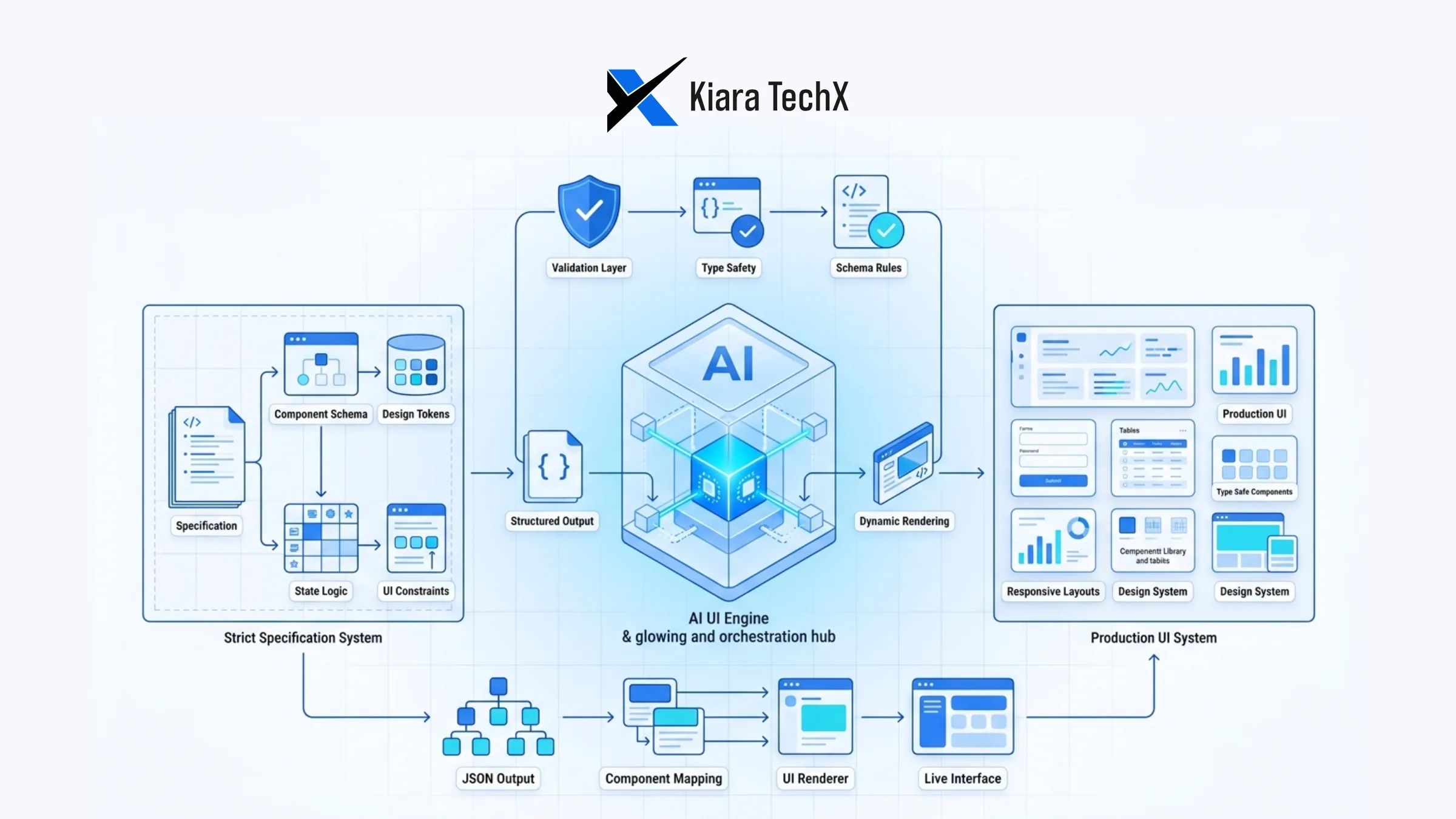
Building on the principles we established in our guide on The Spec-First Revolution, your English or JSON specification must act as a strict compiler constraint. A production-grade Generative UI system relies on three core specification layers:
1. The Component Schema (The Boundaries)
You must expose a rigorous, type-safe manifest of your component library to the LLM. If the model doesn’t know a component exists—or what props it strictly accepts—it cannot use it.
- Strict Prop Types: Define exactly what data types (strings, booleans, specific enums) the component accepts.
- Component Context: Programmatically instruct the model when it is appropriate to use a specific layout.
2. Design Token Constraints (The Guardrails)
Never let an LLM emit arbitrary hex codes or pixel values. The specification must explicitly map to your existing design tokens (e.g., color="primary", spacing="md"). If the model attempts to return color="#FF5733", your validation layer must intercept and reject the payload before it ever touches the DOM.
3. The State & Action Matrix (The Logic)
A beautiful UI is useless if it’s non-functional. Your spec must define exactly how dynamic inputs trigger state changes or API calls. By passing a strict interaction contract to the AI, it can safely wire up click handlers and form submissions to authenticated backend endpoints.
The Architectural Pipeline: From Specification to Rendered DOM
How does this look in practice inside a modern frontend architecture? We break our Generative UI engine down into a four-stage pipeline that ensures speed, safety, and visual consistency.

Step 1: Structured JSON Generation
Instead of asking for raw code, we force the LLM to emit structured JSON that conforms perfectly to our frontend schema using tools like OpenAI's structured outputs or Gemini's schema enforcement. The model outputs a semantic UI tree rather than visual layout code.
Step 2: The Validation Gate
Before anything hits the client's screen, the incoming JSON payload passes through a strict validation layer (using tools like Zod). If the AI introduces a hallucinated prop or an unauthorized component, the validator catches it instantly, falling back gracefully to a standard pre-compiled interface layout.
Step 3: Hydration and Rendering
Once validated, the JSON tree is processed by a dynamic renderer on the frontend. This engine maps the JSON tokens directly onto your production-ready, highly optimized components (built with frameworks like React, Next.js, or Astro).
The Ultimate Benefit: Hyper-Personalization at Scale
Why go through the effort of setting up a spec-driven generative architecture? Because it completely obliterates the bottleneck of traditional software delivery.
- Context-Aware Dashboards: Imagine a B2B SaaS platform where the dashboard layout completely alters itself based on the user's immediate operational crisis—surfacing the exact metrics, graphs, and action items needed for that specific moment, framed perfectly within your brand identity.
- Instant Feature Experimentation: Product teams can test new user flows and interface structures instantly by modifying the system prompt and UI specification file, completely bypassing the traditional code commit, QA, and deployment cycles.
- Drastic Reduction in Component Bloat: Instead of writing hundreds of slight variations of the same card or form component to appease edge cases, developers build a core set of highly resilient primitives and let the spec-driven engine handle layout composition.
How Kiara TechX Approaches Modern Frontend Evolution
At Kiara TechX, we believe that the human developer's role is shifting dramatically. The era of manually writing boilerplate CSS grid layouts and mapping basic input states is coming to a close.
By embracing spec-driven generative UI, engineering teams elevate themselves from pixel-pushers to system architects. We don't build interfaces that are set in stone; we build robust, predictable systems that allow software to dynamically render itself safely in real time.
The frontend of tomorrow isn't static code sitting in a repository-it's an adaptable, intelligent layer that listens to intent, respects the specification, and builds itself on demand.