Remember when deploying a single complex feature required a dozen fragmented Slack threads, endless Jira ticket updates, and a silent prayer to the staging environment gods? We have all been there. Traditionally, the Software Development Life Cycle (SDLC) is a chaotic relay race. A product manager hands off a spec, a designer creates a mockup, a developer writes the code, a reviewer points out critical gaps, and a tester throws it back over the fence when it inevitably breaks.
It is a process defined by friction, context switching, and human bottlenecks. But what if you could remove the mechanical bottlenecks entirely? What if the relay race was run by an untiring, perfectly synchronized team of artificial intelligence agents?
Welcome to the era of the fully autonomous software factory. Recently, we decided to push the boundaries of what custom AI agents can achieve within development environments. Instead of just using AI as an intelligent autocomplete tool, we built an end-to-end automated pipeline.
Enter the Orchestrator
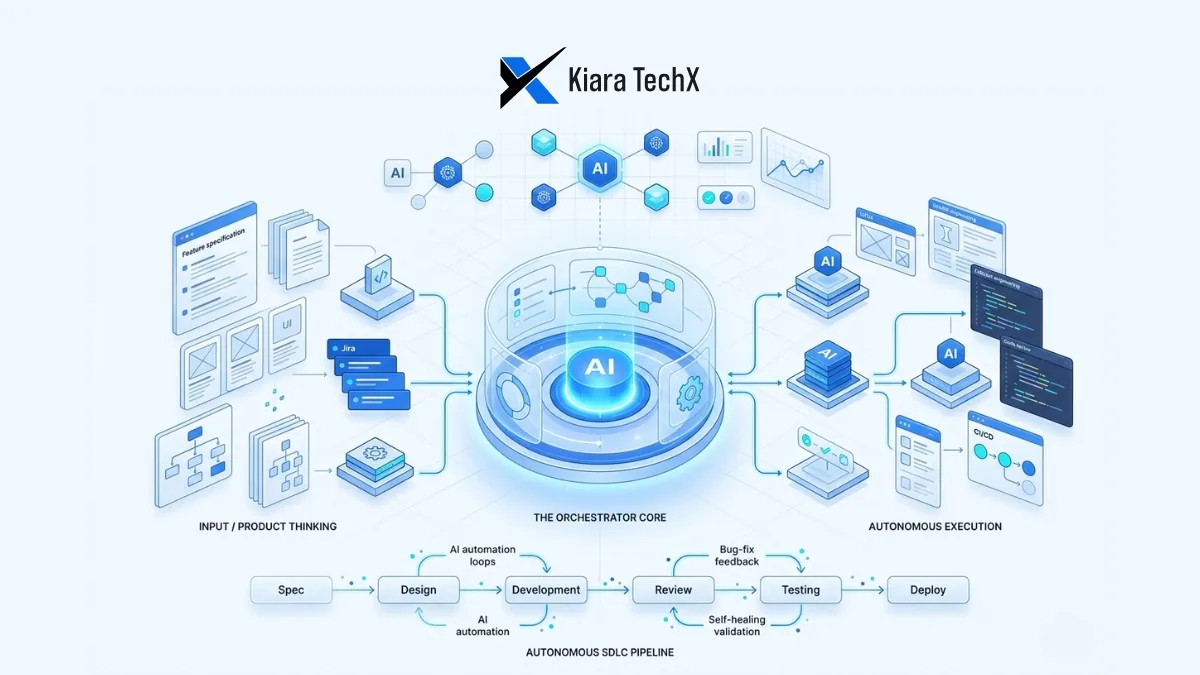
At the center of this autonomous factory sits the "Orchestrator." The Orchestrator does not write a single line of production code. It does not mock up user interfaces, nor does it write unit tests. Instead, it acts as the ultimate technical project manager.
Its sole purpose is to coordinate a team of highly specialized agents: the UI/UX Designer, the Fullstack Engineer, the Code Reviewer, and the Test Engineer. The Orchestrator processes feature specifications sequentially, managing the rigorous feedback loops and ensuring no code moves forward until it is thoroughly designed, built, reviewed, and validated.
While setting up the underlying persona framework for these agents is a massive hurdle on its own, the real magic happens in the execution model.
The Secret to AI Focus: Sequential Execution
One of the biggest mistakes engineering teams make when deploying AI is overwhelming the context window. If you feed an AI ten feature specs at once, it will hallucinate dependencies and produce spaghetti code.
The Orchestrator avoids this by enforcing strict, sequential discipline. It reads the workspace directory, sorts the markdown specs by their numeric prefix, and processes them one at a time. It will not even look at the onboarding module until the organization setup module is flawlessly completed and deployed. This mirrors the focus of a deeply concentrated senior engineer.
The Five-Phase Autonomous Pipeline
To understand why this is a massive leap forward for engineering productivity, let us look at how the Orchestrator processes a single feature specification. It enforces a strict, unyielding order of operations.
- Phase 1: Setup. The Orchestrator reads the current spec and creates an isolated workspace folder. It is clean, organized, and sets a sterile stage for the downstream agents to operate without cross-contamination.
- Phase 2: Design. The Orchestrator assigns the spec to the UI/UX Designer agent. This agent reads the requirements and outputs a comprehensive design plan. The Orchestrator strictly verifies this blueprint exists before moving on.
- Phase 3: Development. Armed with both the raw spec and the design plan, the Fullstack Engineer agent gets to work. It implements the feature from end to end and produces a detailed implementation summary.
- Phase 4: Code Review. Here is where the quality gates close. The Code Reviewer agent analyzes the engineer's implementation against the original requirements to ensure no corners were cut.
- Phase 5: Testing. Finally, the Test Engineer agent takes the reins, executing comprehensive test suites to ensure the feature actually works in a simulated production environment.
The Infinite Patience Loops
Traditional development stalls when code fails a review or a test. Developers get frustrated, morale drops, and tickets pile up in the backlog. AI agents, however, possess infinite patience. We engineered the Orchestrator to handle development failures gracefully through automated, self-healing fix loops.
The Gap Fix Loop:
If the Code Reviewer flags a breaking gap, the Orchestrator does not panic. It generates a clean critical_gaps.md file, stripping away the noise and leaving only the hard blockers. It sends this directly back to the Fullstack Engineer for a targeted fix. The loop repeats - fix, review, fix, review- until every single gap is fully resolved.
The Bug Fix Loop:
Similarly, if tests fail, the Orchestrator distills the test report into a concise bug_report.md containing only the failed test cases. The Fullstack Engineer patches the code, and the Test Engineer re-tests. Only when all tests pass does the Orchestrator declare the spec complete.
This rigorous, autonomous quality assurance prevents the kind of technical debt that silently cripples growing platforms. If you want to dive deeper into why rigid testing environments matter for AI-generated code.
The Kiara TechX Perspective
At Kiara TechX, we fundamentally believe the future of software engineering is not about replacing developers; it is about elevating them to the role of architects. By automating the mechanical, repetitive aspects of the SDLC - the handoffs, the baseline code reviews, the initial testing loops- we free up human intellect to solve complex, high-value business problems.
Our approach to AI orchestration ensures that quality gates are never bypassed for the sake of speed. We build systems that enforce discipline automatically, removing the human error from project management. This is not just a fascinating Copilot experiment; it is a scalable, enterprise-grade blueprint for tech teams who want to ship faster without breaking things.
The Future of the SDLC
The autonomous software development lifecycle is no longer a futuristic concept; it is a living, breathing workflow that turns raw specifications into resilient software. By delegating the heavy lifting to the Orchestrator, engineering teams can finally focus entirely on what to build next, rather than how to manage the build process.
Ready to transform your own development pipeline from a chaotic relay race into a synchronized symphony? Reach out to the Kiara TechX team today to explore our bespoke AI automation solutions and elevate your engineering workflow.