Remember when we all collectively lost our minds because an AI could finish a for loop? Fast forward to today, and the collective anxiety in boardrooms has shifted from mere fascination to an aggressive, almost frantic push to become "AI-first." Every weekly sync brings a new demo. We are flooded with talk of autonomous AI agents, Large Language Models, Model Context Protocols, and Agent-to-Agent workflows.
Leadership wants speed, prototypes, and flashy interfaces that look incredible in a slide deck. On the surface, the momentum feels unstoppable.
But beneath the slick user interfaces and the impressive proof-of-concept (POC) presentations lies a quiet, structural crisis. While everyone is racing to build the penthouse of their AI mansion, very few organizations are checking to see if they are pouring concrete into a swamp. The harsh reality of modern enterprise tech is simple: visibility can launch an AI strategy, but only foundations sustain it.
Mirage of the Top Layer
When an AI initiative fails, it rarely fails at the top layer. The LLM usually generates the text just fine; the chatbot renders beautifully; the automated agent executes its initial command exactly as programmed during the controlled demo.
The collapse happens lower down, in the messy, unglamorous basement of the enterprise tech stack. It fails where systems, legacy workflows, and human decisions were never designed to support automated intelligence at scale.
Most organizations treat AI as a plug-and-play layer, a magical veneer you can slap onto existing systems to instantly multiply productivity. But AI isn't an application; it is an accelerant. If your underlying data is fragmented, your processes are broken, and your team's responsibilities are ill-defined, AI will only help you make mistakes faster and at a much larger scale.
The Five Elements of the Invisible Layer
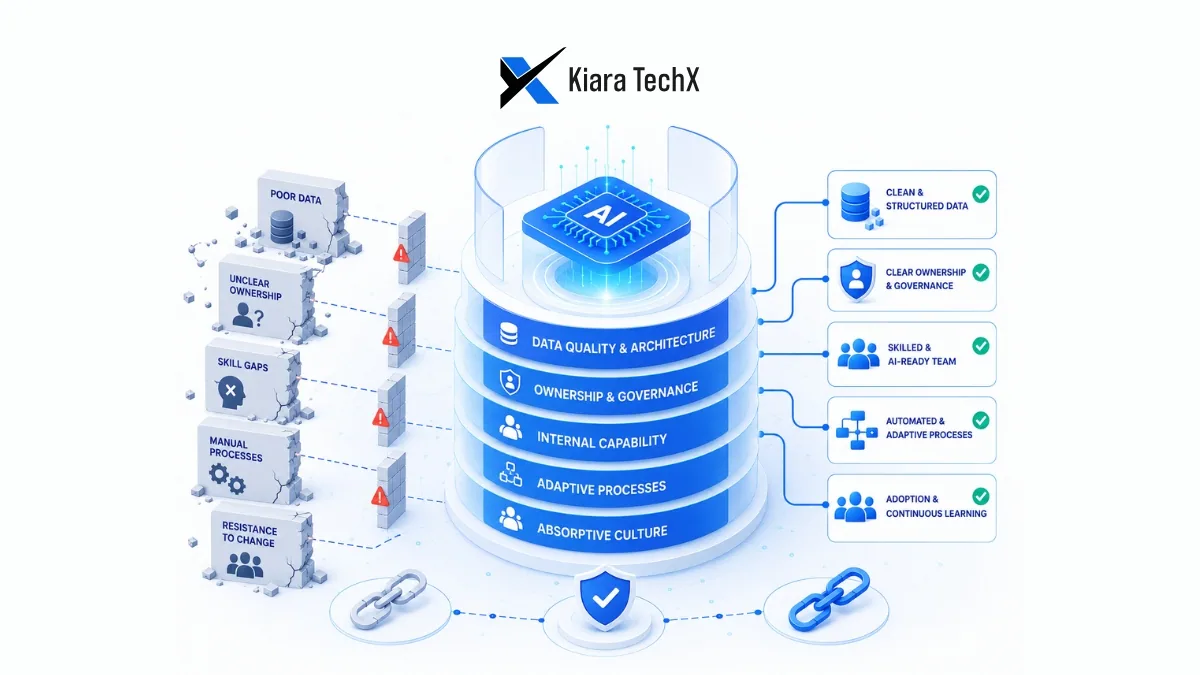
To build something that survives the transition from a cool prototype to a core operational asset, we have to stop ignoring the invisible layer. This layer is composed of five foundational pillars that engineering and leadership teams consistently underestimate:
- Data Quality and Architecture: AI systems eat data and spit out decisions. If your data pipeline is a tangled web of duplicates, silos, and unverified inputs, your AI outputs will be confidently wrong. Clean, accessible, and structured data is the non-negotiable tax you pay for functional AI.
- Clear Ownership and Governance: When an autonomous agent makes an operational error, who owns the fallout? Without explicit frameworks defining who owns the models, the data streams, and the ultimate decisions, deployments stall out due to risk aversion.
- Internal Capability: Buying an AI tool is easy; upskilling your team to understand its limitations, biases, and prompt structures is hard. True capability means moving past basic literacy into deep operational competence.
- Adaptive Processes: You cannot inject a hyper-fast AI agent into a manual, bureaucratic approval chain and expect 10x efficiency. Internal processes must be re-engineered to absorb and match the velocity of automated tools.
- Absorptive Culture: If your workforce views AI as a looming threat rather than an operational lever, passive resistance will quietly kill adoption rates.
While optimizing these foundational elements is crucial, the real challenge lies in shifting organizational mindset from chasing short-term visibility to committing to long-term durability.
Shifting the Internal Narrative
The obsession with speed has created an environment where foundational work is dismissed as "boring." It doesn't generate headlines, and it doesn't look exciting in an annual report. But ignoring invisible problems until they become catastrophic operational bottlenecks is an incredibly expensive way to innovate.
The industry is littered with polished AI POCs that look brilliant in a staging environment but completely crumble the moment they encounter real-world enterprise data variance. They fail because they lack structural integrity.
Instead of constantly asking our engineering teams, "How fast can we adopt this new AI framework?" leadership should start asking a much more uncomfortable question: "Are we building an infrastructure durable enough to actually support it?"
How Kiara TechX Approaches This
At Kiara TechX, we don't believe in building fragile tech. We understand the pressure to deliver immediate, visible results, but we refuse to sacrifice systemic health for temporary applause. Our engineering philosophy is anchored in the belief that an AI strategy is only as strong as the data and workflows feeding it.
When we partner with organizations, we don't just hand over a customized model and wish them luck. We dig into the invisible layer. We audit the data pipelines, optimize the API architectures, and help design the governance frameworks required to make automation safe, repeatable, and scalable. We build the unglamorous, highly resilient foundations that allow your flashiest innovations to stand tall without tipping over.
The Bottom Line
The race to become AI-first is not won by the company that launches the most prototypes; it is won by the company that can successfully operationalize them at scale. Stop chasing the mirage of the top layer and start fixing the foundations.
If you are ready to transition your AI initiatives from fragile proofs-of-concept into durable, enterprise-grade realities, reach out to the Kiara TechX team today to explore our infrastructure optimization solutions.