Remember the “white canvas syndrome”?
That moment when a designer opens a fresh Figma file, stares at an empty frame, and waits for inspiration to decide where the first component should go.
For years, this was considered the normal creative process:
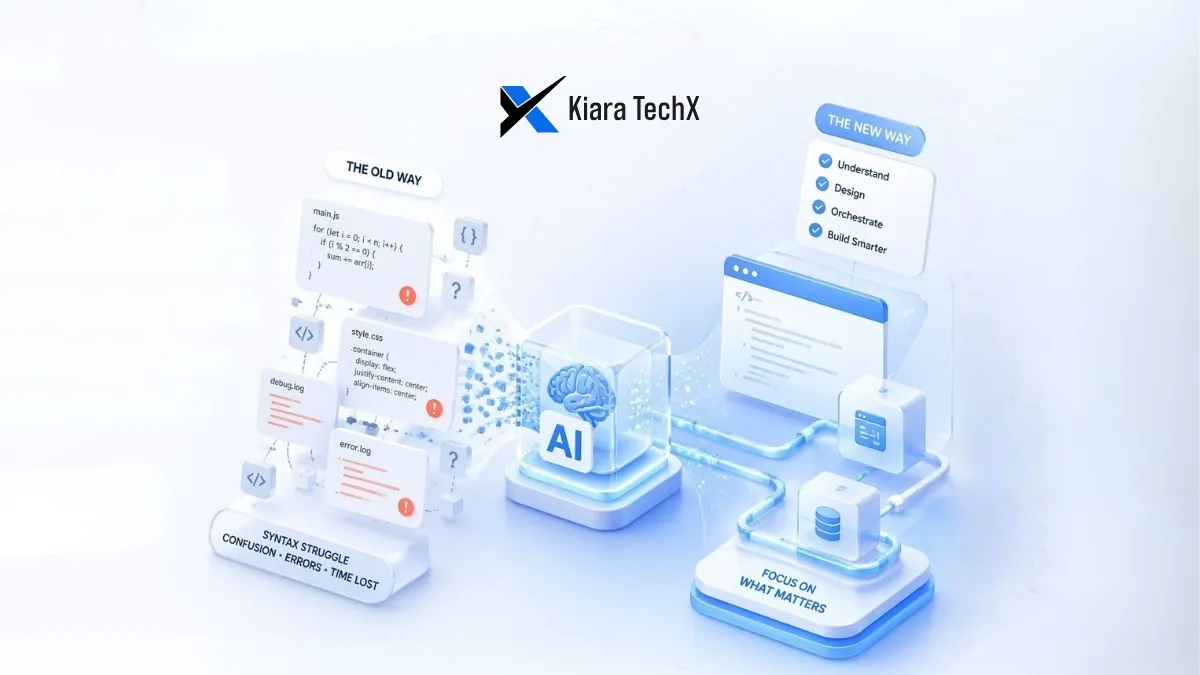
Identify a problem, open a design tool, move pixels around, explore layouts, and eventually discover the right direction.
But in reality, most of that process was structured guesswork.
At Kiara TechX, we’ve fundamentally changed where design begins.
We still use Figma every day. We still care deeply about visual quality, accessibility, and brand systems. But the starting point is no longer the canvas itself.
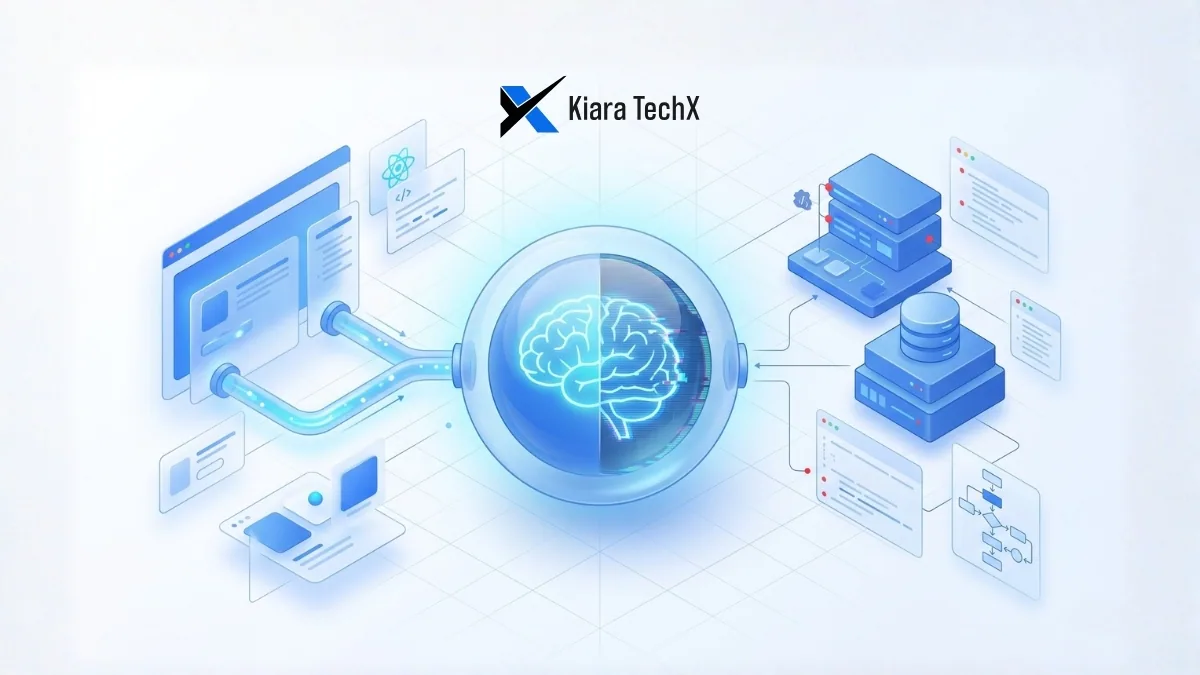
Today, our design workflow begins with intelligence-first thinking powered by AI.
Before a single frame is created, we use AI models to challenge assumptions, map logic, validate flows, reduce complexity, and structure user intent. By the time we open Figma, the hardest part of the process the thinking is already done.
This isn’t about replacing creativity with automation.
It’s about removing ambiguity before execution begins.
Design Was Never Just About Visuals
One of the biggest misconceptions in product design is that design is primarily about aesthetics.
In reality, especially in modern SaaS and AI-driven products, design is structured decision-making.
The real challenges rarely come from choosing button styles or spacing systems. They come from solving clarity problems:
- What exact user problem are we solving?
- Which user intent matters most in this flow?
- What happens when the system fails?
- Where does confusion appear?
- Which information is essential, and which is noise?
- How should the interface adapt across different user states?
Traditionally, designers tried solving logic and visuals at the same time.
That often led to endless iterations, disconnected flows, and late-stage revisions.
Today, we separate those layers intentionally.
We use AI as a strategic thinking partner before entering the UI phase. Logic gets stress-tested first. User flows are validated before screens exist. Microcopy is refined before layouts are designed.
Instead of using Figma to figure things out, we use it to execute a system that already has direction.
The Shift from AI-Assisted to AI-Native Design
The design industry has rapidly evolved beyond simple AI assistance.
In 2026, modern product teams are moving toward AI-native workflows where AI is embedded into the foundation of decision-making itself.
This shift is changing how products are imagined, structured, and delivered.
Today’s workflows increasingly include:
- conversational prototyping
- adaptive design systems
- AI-generated flow mapping
- real-time UX validation
- multimodal interaction planning
- agentic interface thinking
Design is no longer limited to static screens.
Modern products must now consider:
- chat-based interactions
- AI copilots
- contextual assistance
- predictive workflows
- personalized interface behavior
The interface itself is becoming increasingly dynamic.
Users no longer want to navigate complexity manually. They expect products to anticipate intent, reduce friction, and guide decisions proactively.
That changes the designer’s role completely.
What AI-First Design Actually Looks Like
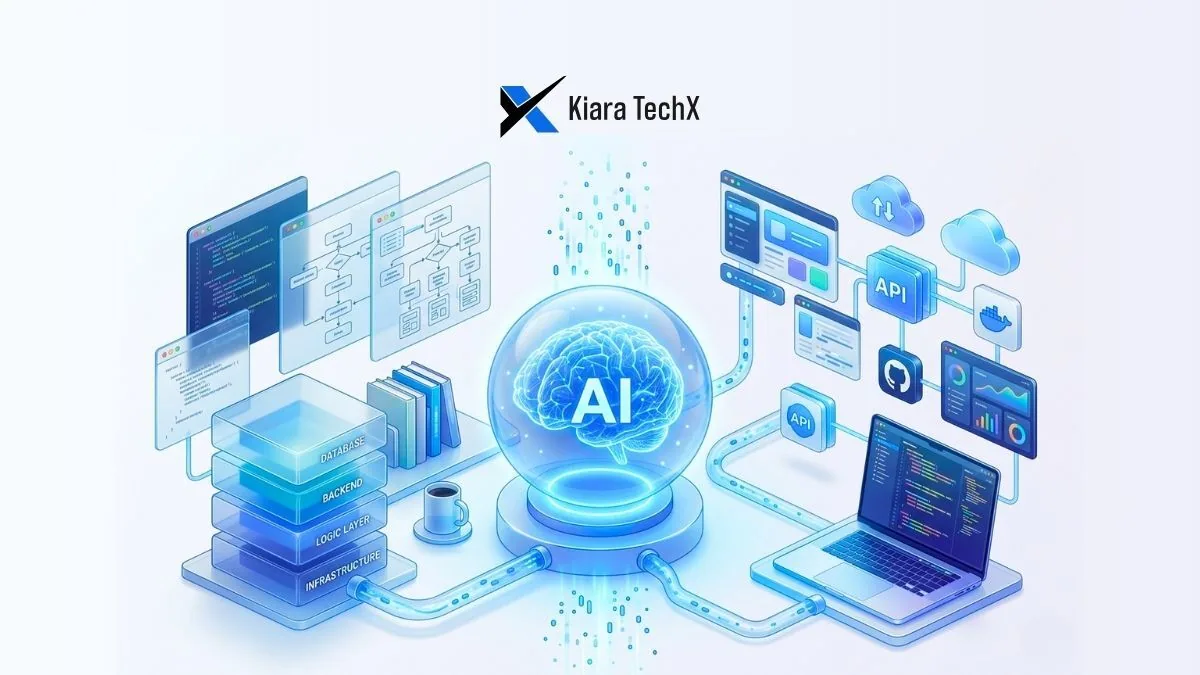
At Kiara TechX, AI-first design does not mean prompting an image generator to “create a dashboard.”
It means using AI to strengthen thinking before execution.
Our workflow typically follows four key stages before visual design begins.
1. Problem Clarification
We feed stakeholder notes, business goals, and product requirements into AI systems and deliberately challenge the assumptions.
We ask:
- Where is the brief unclear?
- Which edge cases are missing?
- What user behavior are we assuming incorrectly?
- Where could this workflow fail?
- Which decisions introduce friction?
This process uncovers gaps early before they become expensive revisions later.
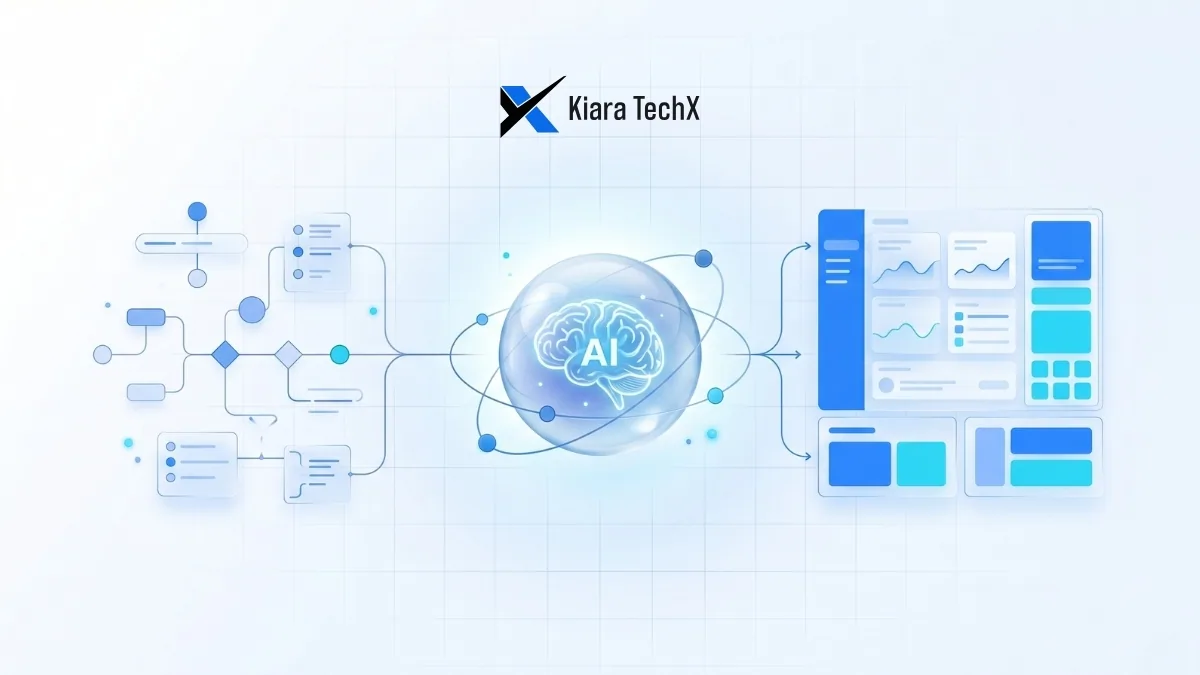
2. Mapping System Logic
Before designing screens, we map behavior.
We define:
- primary user flows
- alternate paths
- failure states
- onboarding logic
- decision branches
- interaction dependencies
AI helps us rapidly structure and validate these systems.
If a workflow doesn’t make sense conversationally, it definitely won’t make sense visually.
3. Content-First UX Thinking
Placeholder copy creates weak UX.
Instead of relying on Lorem Ipsum, we generate and refine real:
- button labels
- onboarding copy
- error states
- empty states
- system messages
- AI assistant prompts
This matters because content defines clarity.
If users need paragraphs of explanation to complete an action, the interface itself is likely too complex.
By refining communication early, the UI becomes significantly more intuitive.
4. Complexity Reduction
One of AI’s biggest strengths is simplification.
We constantly challenge flows by asking:
- Can this process happen in fewer steps?
- Can multiple states become one?
- Is this interaction even necessary?
- Are users making too many decisions?
This helps eliminate unnecessary friction before high-fidelity design begins.
The result is cleaner products, faster execution, and significantly better usability.
Why This Matters Beyond Design
This shift is not just about improving creative workflows.
It directly impacts product quality and business execution.
Faster Strategic Alignment
When stakeholders review designs, they aren’t just reacting to visuals.
They’re reviewing logic that has already been validated.
Conversations become more productive because discussions shift from subjective opinions toward structured product thinking.
Reduced Rework
One of the biggest causes of delays in product development is discovering logic problems too late.
AI-first workflows reduce that risk dramatically by validating systems before visual execution begins.
Less ambiguity early means fewer revisions later.
Better Cross-Team Collaboration
When product managers, developers, and designers align around structured AI-assisted thinking before implementation, handoffs become significantly smoother.
Everyone operates from the same system logic instead of fragmented assumptions.
That level of alignment becomes critical as products grow more complex.
The Designer’s Role Is Evolving
AI is not reducing the importance of designers.
It’s changing what great designers are responsible for.
The modern designer is no longer just an interface creator.
They are becoming:
- flow architects
- system thinkers
- behavioral strategists
- clarity builders
- AI workflow orchestrators
Execution has become faster for everyone.
But speed alone is no longer valuable.
The real differentiator is the ability to think clearly, reduce complexity, and create systems that feel intuitive at scale.
AI can generate options.
But judgment, prioritization, empathy, and brand understanding still require human decision-making.
The designer still decides what matters.
The End of Static UX
Traditional UX assumed users followed predefined paths.
That assumption is quickly disappearing.
Modern AI-native products are becoming increasingly adaptive and contextual.
Interfaces now evolve based on:
- user behavior
- intent prediction
- conversation history
- personalization
- contextual actions
The future of UX is no longer fixed screens connected by static flows.
It’s responsive systems that adapt intelligently in real time.
That means product teams must think beyond layouts and begin designing flexible interaction ecosystems instead.
How Kiara TechX Approaches This
At Kiara TechX, we believe speed without clarity only creates faster confusion.
Our philosophy is simple:
the strongest digital products are built through structured thinking before execution.
We use AI as a cognitive layer within the product design process not as a shortcut for creativity.
By integrating AI at the earliest stages of planning, we ensure that every design decision is backed by logic, clarity, and intentionality.
We are not simply building interfaces faster.
We are building systems that are more aligned, more scalable, and more intelligent from the very beginning.
The New Standard of Product Design
The era of starting with a blank canvas is fading.
By the time our team opens Figma, the priorities are already clear, the flows are mapped, the edge cases are identified, and the logic has been validated.
We’ve replaced guesswork with groundwork.
And in a world where AI has accelerated execution for everyone, the teams that win will not be the ones who move fastest.
They’ll be the ones who think most clearly before they build.
At Kiara TechX, we don’t just design interfaces.
We architect intelligent product systems designed to perform from the very first decision.