The 100,000-Line Problem
We've all been there. You're building a specialized agent-maybe a PR reviewer or a DevOps troubleshooter-and you keep tacking on "just one more rule" to the system prompt. Before you know it, your prompt looks less like an instruction set and more like a Tolstoy novel.
In 2026, the "brute force" approach to context is officially a legacy anti-pattern. While model context windows have expanded to heroic lengths, our ability to use them effectively has hit a wall. If you're still trying to solve agent reliability by stuffing more text into the top of the chat, you're not building a solution; you're building technical debt.
The Context Paradox: More Isn't Always Better
It's tempting to think that a 2-million-token context window solves everything. But for production-grade agents like Claude Code or Cursor, "big context" comes with a "big tax."
"Lost in the Middle": Even the smartest models lose precision when forced to navigate a sea of irrelevant instructions. Critical rules buried deep in a 100,000-line prompt are effectively invisible.
The Latency Tax: Prefilling a massive context window every time an agent takes a sub-step is the fastest way to turn a "snappy" AI into a spinning wheel of frustration.
The Cost: In the world of agentic orchestration, tokens are currency. If your agent reads the same 50,000 lines of instructions for every 10-line code change, your ROI is evaporating before your eyes.
Enter "Agent Skills": The Modular Evolution
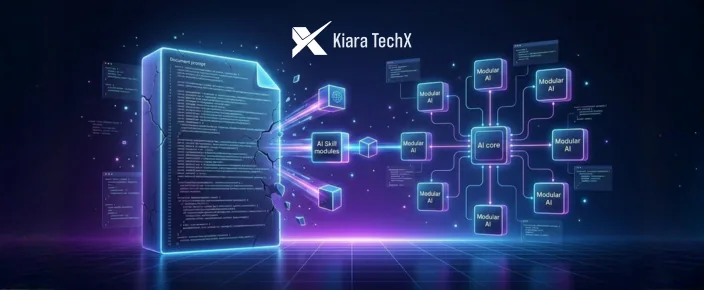
The industry is moving toward Agent Skills. Instead of a monolithic system prompt, we are seeing the rise of modular, Just-in-Time (JIT) context injection.
Think of it like this: When you hire a new developer, you don't hand them the company's entire historical archive and tell them to memorize it before they fix a bug. You give them the documentation for the specific microservice they're touching.
How it works in practice:
Skill Manifests: Agents carry a "manifest" of available skills (e.g., SQL_Optimization, SaaS_Security_Audit, React_Refactor).
Dynamic Loading: The orchestrator detects the user's intent and "injects" only the relevant skill prompt and tool definitions for that specific task.
Standardization via MCP: The Model Context Protocol (MCP) has become the universal "USB port" for these skills. A skill written for a custom internal agent can now be plugged directly into Claude or an IDE-based agent without a total rewrite.
Why This Changes Everything for Orchestration
This shift from "static prompts" to "dynamic skills" is the key to true agentic orchestration-and unlocks what we call Digital Assembly Lines.
Portability: Your "Company Coding Standards" skill can live in a central repository and be injected into any agent, whether it's a standalone chatbot or an IDE extension.
Reduced Friction: By only injecting context as needed, we maximize KV-cache hits. This means faster response times (TTFT) because the model doesn't have to re-process the "stable" parts of its personality every time.
Intelligent Fits: A skill-based agent is more effective because it isn't distracted by noise. It has 100% of its attention on the 5% of your codebase that actually matters for the task at hand.
Business Value: Efficiency Meets Autonomy
For technical leaders, the move to Agent Skills isn't just a "cool dev trick"-it's a business necessity.
Scalability: You can deploy 100 specialized sub-agents for the cost of one "generalist" behemoth.
Maintainability: Updating a global "Security Protocol" skill automatically updates every agent in your organization simultaneously.
Production Readiness: Modular skills are easier to test, version-control, and audit than a giant, sprawling system prompt.
Conclusion: The Future is Composable
The future of AI isn't about how much an agent can hold in its head; it's about how quickly it can grab the right tool for the job. At Kiara TechX, we're seeing that the most successful agentic deployments aren't the ones with the longest prompts-they're the ones with the most elegant orchestration.
The "mega-prompt" is dead. Long live the modular skill.