From Code Completion to Full Orchestration
Remember when we all collectively lost our minds because an AI could finish a for loop? That was a fun weekend. But in 2026, saying "AI can complete my code" is like saying "I have a calculator that does addition." It's table stakes.
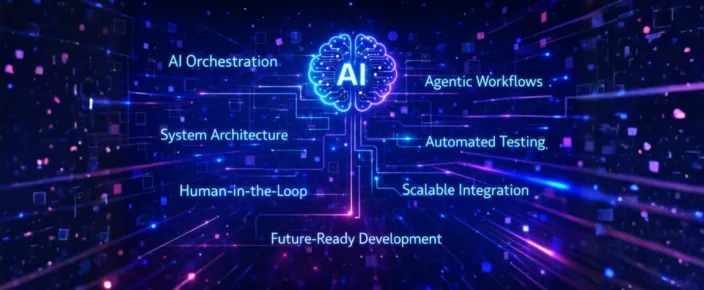
We've officially moved past the "Wow" phase and into the Era of Orchestration. With agentic frameworks now standard in our IDEs, we aren't just getting snippets; we're getting full-fledged features, integrated test suites, and automated refactors in a single push.
Technical Debt: New Tool, Same Old Story
There's a common fear that AI-generated code is just a factory for technical debt. Here's the reality check: humans have been "perfecting" the art of technical debt since the first line of Fortran. Debt isn't an AI problem; it's a process problem.
If you use AI to "fire and forget," you're building a digital house of cards. But if you treat your AI as a high-speed junior developer that requires rigorous human review, the debt becomes manageable. The key is the iterative process. By involving humans more deeply in the review and architectural phases, you can catch logic drift before it becomes a legacy nightmare.
From Bricklayers to Architects: The Great Role Migration
The question isn't "Will AI replace me?" but "How fast can I become an Architect?"
The manual labor of writing boilerplate and basic CRUD operations is being offloaded. This shifts the team's focus toward:
System Architecture: How does this new feature impact our overall scalability?
Logic Verification: Does the AI's solution handle the edge cases of our specific business domain?
Security Orchestration: Ensuring the agent didn't "hallucinate" a vulnerable dependency.
At Kiara TechX, we've seen this first-hand. In our internal projects, AI isn't just a tool; it's an orchestrated team of agents. We've reached a point where nearly 100% of the initial lines of code are AI-generated, but 100% of the direction is human-led.
2026: The Milestone of Integration
The true differentiator this year isn't who has the best AI model - it's who has the best AI workflow. The "single line completion" era is dead. We are now in the phase of:
Full-Feature Generation: Prompting for a complete module and getting it.
Agentic Testing: AI agents writing their own automation tests to verify their own code.
Iterative Refinement: Humans providing high-level feedback that the AI uses to refactor the entire PR.
The goal is to move faster without breaking things - or at least, having the AI fix what it breaks before it ever hits production.
Kiara TechX Value Integration
Scalable Architecture First: At Kiara TechX, we leverage agentic AI to speed up development, but our senior architects maintain the final "human-in-the-loop" gate to ensure your product remains maintainable for years, not weeks.
Future-Proof Workflows: We don't just build products; we help our partners integrate the latest AI-driven workflows to ensure their internal teams stay ahead of the technology curve.
Conclusion
The Era of Orchestration is here, and it's reshaping how we build software. AI isn't replacing developers - it's elevating them from code writers to system architects. The winners in 2026 aren't those with the best AI models, but those with the best AI workflows and the discipline to maintain human oversight where it matters most.
At Kiara TechX, we're not just adapting to this change - we're leading it, helping our partners build scalable, maintainable products that leverage the full power of AI-driven development while maintaining the architectural excellence that only human expertise can provide.